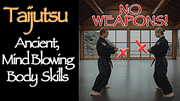
Taijutsu is a Japanese martial art that focuses on hand-to-hand combat techniques. It teaches the body’s natural movements to defend oneself or neutralize an opponent. It is often referred to as “the art of body movement.” It is deeply connected to various Japanese martial traditions. Most notably might be the Bujinkan, a martial arts organization that trains in historical Japanese combat techniques. But there are many martial arts forms that are grounded in taijutsu – even Tai Chi. Bujinkan and other Ninjutsu forms of martial arts rely on weapon-free tactics. Other schools do, too. For example “karate” means “empty hand.”
Watch our free videos below!
What is Taijutsu?
The word “Taijutsu”, literally translated as “body technique” or “body skill,” refers to a system of martial arts that emphasizes physical coordination, balance, and body mechanics for combat. Unlike some martial arts that focus primarily on striking or grappling, The study of Taijutsu incorporates a wide variety of techniques. This includes joint locks, throws, and defensive maneuvers and more. Such tactics are designed to exploit an opponent’s weaknesses, maintain balance, and counter an attack efficiently.
One of the primary features of Taijutsu is that it does not require the use of weapons. However, taijutsu training is useful to incorporate with weapons training, which is often integrated into the training curriculum of many schools. The techniques of Taijutsu are often designed to be adaptable in different scenarios, whether in close-quarters combat or when dealing with armed attackers. For example, you may start a self-defense scenario with taijutsu techniques that don’t require any weapons on your body. But then you may be able to take away the weapon of your attacker in the process. So, you should know what to do in that scenario as well.
Learn about Taijustu from these free videos on our Tube Channel:


History of Taijutsu
The history of Taijutsu has roots in various traditional Japanese martial arts, including the ninjutsu (the art of the ninja) and bujutsu (combat techniques). It was historically practiced by the samurai and ninja. In fact, much of Taijutsu’s techniques can be traced back to the combat methods used in feudal Japan, which were passed down through the generations in various schools or ryūha. These schools taught different aspects of hand-to-hand combat, along with strategies for survival in battle that don’t rely on weapon techniques.
The modern form of Taijutsu is often associated with Bujinkan, an organization founded by Masaaki Hatsumi in the 1970s. The name of the martial art is actuall “Bujinkan Budo Taijutsu”. Hatsumi’s teachings integrate various traditional martial arts schools, including the Togakure-ryū (ninjutsu) and the Kukishinden-ryū (a school of battlefield tactics). Under Hatsumi’s guidance, Taijutsu has become a prominent aspect of the Ninjutsu martial art, attracting students worldwide who wish to learn not only how to fight but also the historical context of these techniques.
Modern Day Practice
In modern practice, Taijutsu is still largely taught through dojos and is practiced by martial artists around the world. The art retains a focus on practical self-defense and is often practiced by people of all ages and backgrounds. It is not only about learning physical combat techniques but also understanding how to use one’s body effectively. This promotes good health, flexibility, and balance. Many people practice it for learning body control, balance, self control, controlled breathing, relaxation and mediation. The forms of Taijutsu can be learned without any intention of engaging in physical conflict.
Practitioners of Taijutsu for self-defense purposes typically begin by learning the fundamental techniques, such as the basic stances, strikes, and defensive movements. Over time, they progress to more advanced concepts, like throws, joint locks, and counter-attacks.
Additionally, weapons training (involving tools such as the katana, bo staff, and shuriken) may be integrated into practice. Taijutsu, as taught in the Bujinkan, emphasizes the development of mental awareness and the ability to remain calm and focused in high-pressure situations. It fosters not only physical skill but also strategic thinking, as students learn to anticipate and respond to an opponent’s movements.
More about Taijutsu – books and websites
Absolutely! Here’s a more casual, conversational version for you, with links where possible:
If you’re looking for solid books on taijutsu, start with Taijutsu: Ninja Art of Unarmed Fighting by Masaaki Hatsumi — it’s pretty much essential. Then there’s Essence of Ninjutsu: The Nine Traditions by Hatsumi as well, which gives you more of the tradition and mindset. Another really good one from him is Advanced Stick Fighting, which, even though it’s about weapons, teaches a lot about body movement that applies directly to taijutsu.
Stephen K. Hayes’ Ninja book series (Volumes 1–6) are classics — you’ll find great explanations and philosophy that pair really well with practice. If you’re into the deeper thinking side, The Ethical Warrior by Jack Hoban is worth checking out. He’s a top Bujinkan teacher who connects martial arts with values and ethics. And for a historical and philosophical dive, Robert Bussey’s Warrior Quest is also solid reading.
Online, you can head to Bujinkan.com for the official home of Bujinkan taijutsu. Another great site for just Taijutsu, specifically is the Taijutsu Fundamentals site. For video learning, definitely check out the playlist of official videos playlist by Bujinkan Greece with a collection of videos from the home dojo of Soke Hatsumi — lots of great footage straight from Japan.
This content has been verified. You can trust our information about Taijutsu from authentic sources.